// AI-Assisted Plan Review

Weeks of Plan Review,
Fast-Tracked.

QualRivu brings disciplined, AI-assisted Plan Review to civil engineering firms and municipalities across Canada. The AI reads the drawings. Deterministic code computes, measures and cites. Your licensed engineer or designated reviewer holds every determination.

Next: product
Design Submission Review Scanning
✓ Roadworks & Drainage Standards PASS
✓ Traffic Signals & Lighting Standards PASS
✓ Watermain & Sewer Standards PASS
✓ Drafting & Material Standards PASS
✓ Lot Grading & Erosion Control Standards PASS

A 40-sheet set is flagged in less than 10 minutes.

// Product

The whole review, not just the AI pass.

The AI pass is one step. Standards intake, workflow, deterministic verification, collaboration and release are the rest - all in the browser, designed to raise submission quality and streamline reviews.

Your Standards, Encoded

The AI turns manuals, bylaws and specs into reusable audit rules: a living library of your jurisdiction's requirements.

Compliance Checks

Deviations from bylaws and standards are flagged as markups on your drawings, every finding engineer-verified before sign-off.

Deterministic Verification

Counts, spacing, clearance and curve values are computed, not read off the sheet; the code's verdict replaces the AI's. Every citation resolves to your standards library.

Cross-Sheet Consistency

Sheet references and section cuts resolve to their details; a structure or pipe drawn across sheets reconciles to one rim, invert, size and material. Mismatches surface as findings, not surprises.

Snap-to-Vector Measurement

Full-resolution sheets, with measurement tools that snap to the drawing's CAD vectors - real linework, not a pixel estimate.

Workflow

Defined roles, assigned drawings, review status tracked in one submission-to-decision pipeline; dashboards roll up the team's progress. A transparent, traceable record holds every action.

Real-Time Collaboration

Work the same drawing with live cursors, or on your own. Built for iPads and tablets: lose connection mid-sheet and markups queue on the device, syncing on reconnect.

AI Chat

Ask about the whole drawing, or draw a box to ask about just one region. Answers cite the exact standards section and pull in cross-referenced sheets for full context.

Canadian Data Residency

Drawings, audit records and project data stay in Canada (Azure Canada Central), application and database alongside. No AI training on your data; encrypted in transit and at rest. Dedicated deployments can use your own servers or cloud.

Next: how it works

// How It Works

The Workflow

From defining your standards to releasing the decision: four steps that replace weeks of back-and-forth.

1

Define Standards

The AI converts engineering manuals into structured audit rules: a digital library of your jurisdiction's requirements.

2

Intelligent Analysis

Upload the set. QualRivu reads what is printed, computes each verdict in code - measuring the CAD vectors directly for utility clearance - and pins a markup where it applies, with the clause checked and the action required.

3

Collaborative Review

Your team works the same drawing, together or on their own time. Verify findings with measurement tools; accept, reject or discuss each one; then clear the Design Checklist for what the AI missed. The reviewer holds every determination.

4

Export & Release

Export drawings with markups to PDF, readable as comments in any PDF reader. Release as Revisions Required, Approved or Rejected; markups land on the submitter's drawings and the record is read-only.
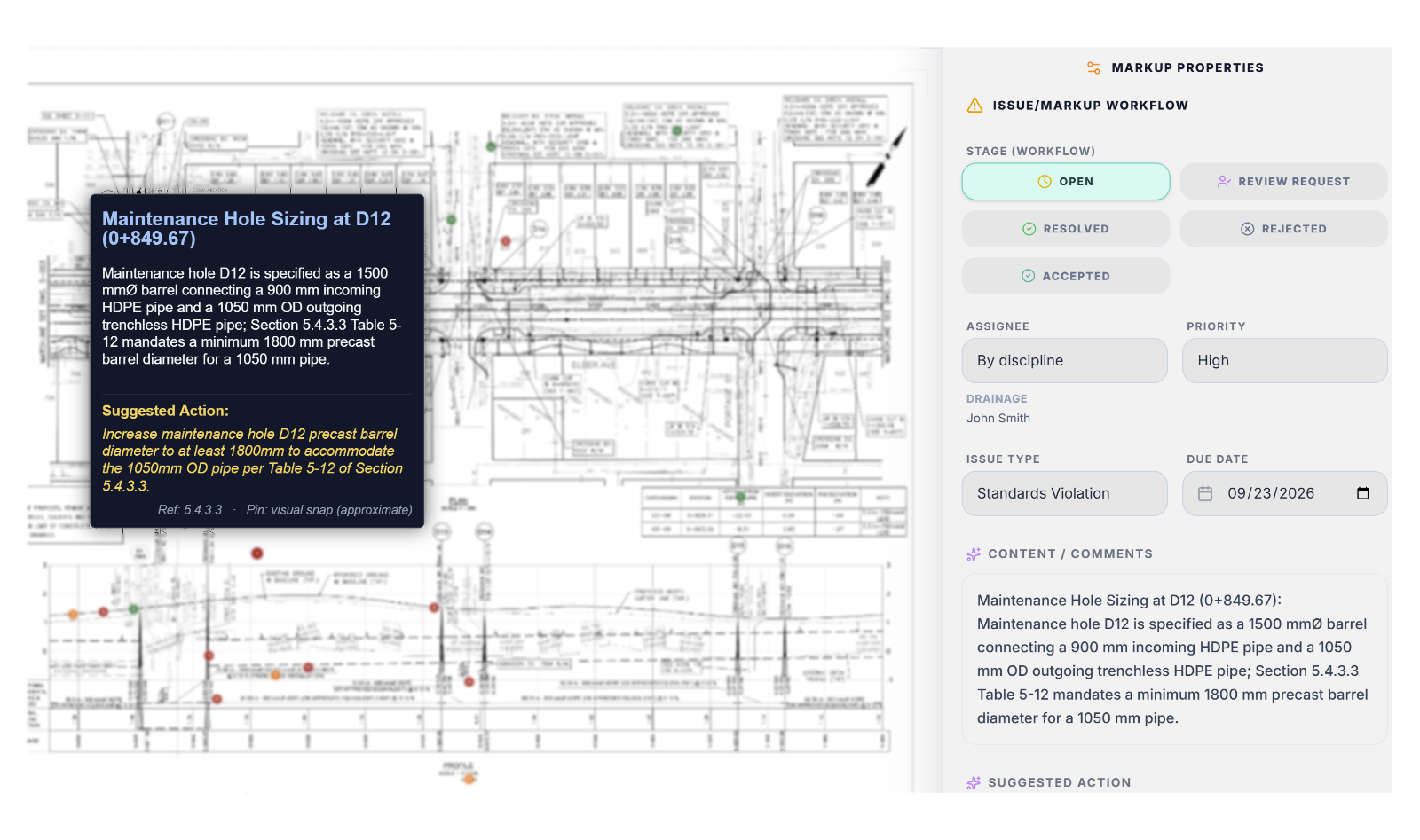
The QualRivu review canvas: a finding for an alignment deflection drop at sanitary manhole S19, pinned to a plan and profile sheet and quoting the standards section it breaches and its suggested fix, beside the markup properties panel showing workflow stage, assignee, priority, issue type and due date.
A finding pinned where it occurs on the drawing, cited to section, carrying its own workflow state. Fictional sample set.

Download the sample review drawing Desktop · findings in your PDF reader's Comments pane · PDF 1.4 MB

Download the phone edition Drawings with numbered pins, then every finding listed · PDF 1.5 MB

3 sheets · 85 checks · a rough AI pass, not engineer-verified

Next: why it holds up

// Why it holds up

An AI model can read a drawing. It can't be trusted to do the math or cite the clause.

Pointing a capable AI model at a drawing produces a demo, not a review tool. Examples of failure modes we engineered out:

Plausible-but-wrong citations

What happens

A vertical curve is annotated K=4.1, and the model cites "section 4.1" - a sanitary sewer clause - because the number looks like one. Nothing looks wrong until someone opens the standard.

How it's handled

Every citation must resolve to a real section of the jurisdiction’s standards before it is shown, in the right discipline: a road finding cannot carry a sanitary clause.

A note is not a hydrant

What happens

A note reading “REMOVE AND DISPOSE OF EX. HYDRANT” mentions a hydrant, and the model counts one. Six mentions become six hydrants where the drawing shows two.

How it's handled

Counts are reconciled against the drawing's CAD layers, where each hydrant has an exact position; prose can confirm attributes, never invent a feature. Sheets without those layers mark counts as model-only.

Two more, in the same shape

The reference package that was wrong for the sheet

What happens

A resurfacing sheet is sent the watermain, storm and sanitary details on every model call - trenches it does not cut. Irrelevant references add cost and invite irrelevant findings.

How it's handled

Which reference sheets accompany a drawing depends on what it actually does. A pavement-restoration sheet gets the utility details because it repairs a trench; a resurfacing sheet does not.

The ambiguity that must not be resolved

What happens

A standards library states three minimum widths for a cycling facility: painted, one-way protected, two-way protected. A drawing naming none could be judged against any; picking one is a coin-flip.

How it's handled

Where the drawing does not say which sub-type applies, the check uses the most lenient limit, so it can only fail a design that fails under every reading - and the finding says what the reviewer must confirm.

None of this was fixed by a better model. Each case is a decision the model does not get to make.

Next: who we are

// About

Built for the Canadian infrastructure landscape.

QualRivu was founded to address one of the most persistent bottlenecks in Canadian infrastructure: the design review process, which currently takes weeks or months, stalling projects and adding cost. QualRivu checks a full set in minutes, so reviewers spend their time deciding, not searching.

We are building the review layer between a submitted drawing set and a signed decision: the standards a jurisdiction actually enforces, the arithmetic that proves compliance, and the record of who decided what.

Federally incorporated - Corporations Canada
Canadian data residency - drawings and records stored in Canada
Built for PIPEDA and FIPPA
SR&ED and NRC IRAP aligned R&D program

The Founding Team

Alex MaCo-Founder Bio

Alex is a transformation and program delivery leader with nearly two decades of experience running complex initiatives for global enterprises, raising operational performance through technology-enabled innovation. Working on large-scale, mission-critical projects exposed a clear industry opportunity: using AI to make engineering reviews more streamlined, consistent and accurate, while reducing risk and cost.

At QualRivu, Alex brings deep expertise in quality management and process improvement, with a practical understanding of how AI can enhance, rather than replace, engineering judgment.

George OtienoCo-Founder Bio

George is a civil engineer with 20 years of experience in municipal infrastructure planning, design review and project delivery. That means following work from the first plan to the finished street, and knowing where problems tend to hide along the way.

At QualRivu, George brings that perspective to how the product is built. Years of assessing submissions against local standards show what a reviewer needs: the right requirements for each drawing, clear findings to act on, and a record of who checked what. The platform puts those essentials first, helping engineers find issues faster while keeping a qualified professional in charge of every decision.

Andreas WeberCo-Founder Bio

Andreas is a technology and product leader with more than a decade of experience delivering digital transformation across enterprise software, utilities and mining. His background spans data analytics, cloud platforms, smart infrastructure and complex programs, with a focus on translating operational challenges into practical solutions.

At QualRivu, Andreas brings that range to modernizing design review, applying AI to help municipalities and engineering firms reduce manual effort, strengthen collaboration and make the process more consistent and traceable, while keeping professional judgment central to every decision.

Next: common questions

// FAQ

Common Questions

The questions municipalities and consultants ask first.

What is QualRivu?
QualRivu is a collaborative review platform for the municipal engineers who assess submissions and the consulting engineers who prepare them. Developers see fewer resubmissions. It checks design sets against your local bylaws and standards, raising quality on the way in, streamlining the review process and leaving every determination traceable.
How does QualRivu help in engineering reviews?
It is a second reviewer that never skips a sheet. The model reads what is printed; deterministic code computes what is read and checks it against the drawing - a callout against the line it points to, a profile's levels against the plan above it, a detail against the sheet that calls it up. For vertical and horizontal separation between utilities, the code measures the CAD vectors directly. Each finding is pinned on the drawing where it applies and cited to the clause it tests; what needs judgment goes to the Design Checklist.
Can consultants review their own drawings before sending them out?
Yes. Consulting engineers can complete a pre-submission review before sending drawings to the client: the same checks against the jurisdiction's standards, each finding pinned to the sheet and cited to the clause it tests. Fix what it flags, then send a cleaner set - fewer comments come back and fewer resubmissions follow.
Is the AI meant to replace my engineering judgment?
No. QualRivu augments it: the platform surfaces potential issues and extracts data, but every finding still requires verification and sign-off by a qualified engineer. The tool streamlines the review; the licensed engineer stays in control.
Why QualRivu, and not a general-purpose chat assistant?
AI alone is not dependable; the workflow around it is what makes the review reliable. A chat assistant reads what is printed and answers plausibly - differently each time you ask. It cannot measure the geometry in the file, it does not hold your jurisdiction's standard, it leaves no record, and the drawings leave your control the moment you paste them in. QualRivu is that workflow: your standards ingested into a rule library, deterministic code doing the measuring and the arithmetic, every finding pinned to its sheet, station and clause, and a trail showing who accepted what - isolated to your organization, stored in Canada, and never used to train a model. The output is an auditable record, not a chat transcript.
What are the limitations of AI-assisted review, and how does QualRivu handle them?
An AI model reads what is printed and QualRivu computes what is read; neither exercises engineering judgment. The platform is built around that. On critical checks the AI only transcribes the values printed on the sheet, and deterministic code does the arithmetic and issues the verdict - repeatable and testable. Every finding stays advisory until a reviewer accepts, rejects or discusses it, and clicking one lands at its exact location, where the measurement tools make verification seconds of work. It separates "checked and passed" from "could not verify" and records where every value came from, so gaps stay visible. The Design Checklist closes the gap: your jurisdiction's expected checks become a list the reviewer works through, so what the AI could not judge, or missed entirely, is still asked and answered.
How secure is my project data?
Your drawings, audit records and project data are stored in Canada (Azure Canada Central), with the application and database in the same region, encrypted in transit and at rest, and isolated per organization. On a dedicated deployment, storage and database run on your servers or cloud account. Your drawings are never used to train AI models. SOC 2 Type II is on the roadmap. Our Security page sets out what sits where.
How can I connect my own jurisdiction's standards?
The Standards Generator ingests your specifications, bylaws and codes and extracts the rules into a structured, reusable library that every submission is checked against: your jurisdiction's requirements, applied consistently.
What types of engineering drawings can the platform process?
CAD-exported vector PDFs: water, storm and sewer plan and profile sheets, site plans, street lighting, traffic signals, lot grading plans, design sheets, details, roadworks including active transport, markings and signage, road geometry, pavement rehabilitation/restoration, cross-sections and more. From a 30% concept set to an Issued-for-Construction package, QualRivu parses the layers and data bands. Some drawings, such as lift stations and detention tanks, are reviewed at a high level rather than in detail.
What is the typical turnaround time for a complete drawing set audit?
A typical set (20 to 40 sheets) is scanned and flagged in about 5 to 10 minutes, so your team moves straight to reviewing findings.
Next: book a demo

// Contact

Ready to streamline your reviews?

Book a 30-minute demo and see QualRivu run on your team's real workflow.

Book a Live Demo See a full workflow walkthrough with your team
Based in British Columbia Serving municipalities and firms across Canada
hello@qualrivu.ai We respond within one business day

We'll only use this to arrange your demo.