// Disciplined AI Review for Civil Engineering
QualRivu brings automated plan checking to municipalities and civil engineering firms across Canada, with the discipline a high-consequence review requires. The AI model reads, deterministic code computes and cites, and your licensed engineer or designated reviewer holds the determination.
// Product
The AI pass is one step. Standards intake, deterministic verification, measurement, collaboration, records and export are the rest.
The AI turns manuals, bylaws, and specs into structured, reusable audit rules: a living library of your jurisdiction's requirements.
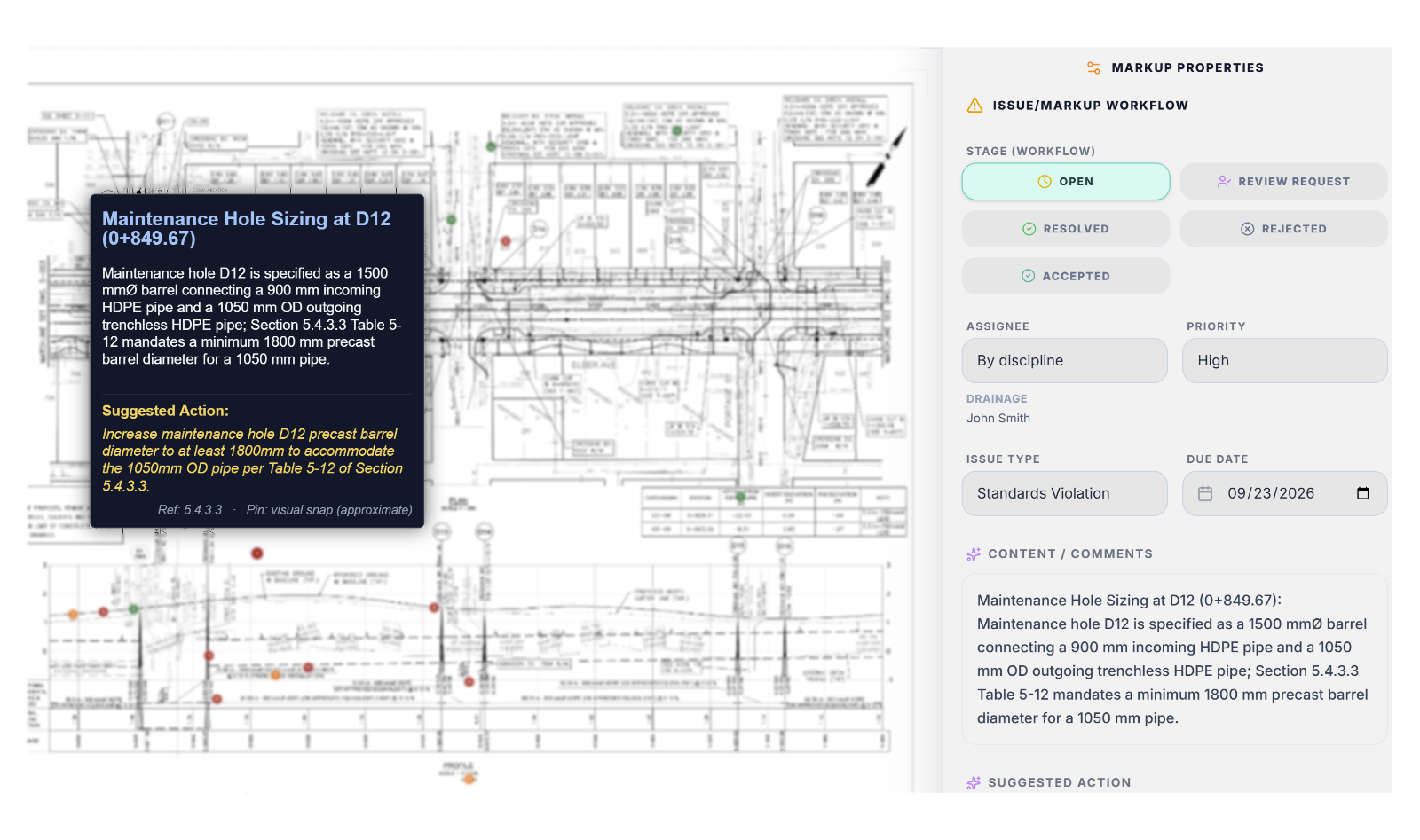
The AI flags deviations from bylaws and standards and places spatial markups on your drawings, with every finding engineer-verified before sign-off.
The AI only extracts: lengths, counts, spacing and verdicts are computed in code, and citations resolve to a verified section.
Measurement tools snap to the drawing's underlying CAD vectors, so engineers verify findings (lengths, spacings, clearances) against real linework, not a pixel estimate.
Automate the submission-to-decision pipeline: route drawings, track review status, and manage conditional approvals. Live dashboards roll up every project's findings and progress at a glance.
Cross-references resolve across the submission, and structures and pipe runs shown on multiple sheets are reconciled; mismatches surface as findings, not surprises.
Create teams, define roles, and work the same drawing with live cursors; add markups and submit comments for review.
Ask the AI about a detail on the drawing; answers cite the exact standards section.
A complete history of every review, finding, and verified action, for full accountability.
Lose connection on site? Keep auditing; changes sync back when you reconnect.
Built for iPads and tablets: native pinch-to-zoom and finger-friendly floating toolbars.
Your drawings, audit records and project data are stored in Canada (Azure Canada Central), with the application and database running in the same region. Built with PIPEDA in mind, with a clear SOC 2 roadmap.
// Why it holds up
Pointing a capable AI model at a drawing produces a demo, not a review tool. What makes it one is everything built around the model. Two failure mode examples we found on real drawing sets, and what each now does instead:
What happens
A vertical curve is annotated K=4.1, and the AI model reports the finding against "section 4.1" (a sanitary sewer clause) because the number looks like one. Nothing looks wrong until someone opens the standard.
How it's handled
Every citation resolves to a verified section of the active standards before it is shown. Numbers that merely look like clause references are rejected, as are cross-discipline mismatches: a road finding cannot carry a sanitary clause. The list it checks against is the jurisdiction’s own ingested standards, not a generic code library.
What happens
A construction note — “REMOVE AND DISPOSE OF EX. HYDRANT” — mentions a hydrant, and the model counts one. Six mentions become six hydrants where the drawing shows two.
How it's handled
The inventory is reconciled against the drawing's own CAD layers: hydrants and valves live on separate layers with exact positions, so prose can confirm attributes but never invent a feature. Where those layers are missing or unrecognised the reconciliation cannot run, and the sheet carries a warning that its counts are model-only and need checking by hand.
// How It Works
From defining your standards to a signed export: four steps that replace weeks of manual back-and-forth.
A submission arrives as an attachment. Comments come back as a marked-up PDF export. Questions live in reply-all threads. Three weeks later, nobody can say which version was actually reviewed, or whether comment #14 was ever resolved.
One place, one version: reviewers, submitters and PMs work the same sheets, with roles deciding who can flag, resolve or approve. Questions attach to the markup they're about. Every item carries a disposition, so review state is a fact you read, and the memorandum and marked-up package assemble themselves from the record.
The AI transforms engineering manuals into structured audit rules, building a digital library of your jurisdiction's unique requirements.
Upload drawings for automated AI scanning. QualRivu flags violations and warnings and places markups with suggested corrections. Model perception is then checked by deterministic rules: arithmetic and citations computed in code, not trusted from the AI.
Your team works the same drawing, together or on their own time. Live sessions share cursors, so you can point at what you mean. Verify AI-flagged findings with measurement tools, accept, reject or discuss each one, then clear the Design Checklist to catch what the AI missed. The reviewer holds every determination.
Generate memorandums and structured design data tables, linking every finding directly to its drawing. Export drawings with markups to PDF and view comments in Acrobat or other PDF readers.
// About
QualRivu was founded to fix one of the most persistent bottlenecks in Canadian infrastructure development: the design review process. What should take days routinely takes months, stalling projects and adding unnecessary cost to municipalities and developers alike.
We are building the review layer that sits between a submitted drawing set and a signed decision: the standards a jurisdiction actually enforces, the arithmetic that proves compliance, and the record of who decided what.
Headquartered in British Columbia, QualRivu Inc. is federally incorporated and built to serve municipalities and civil engineering firms from coast to coast.
The Founding Team
Alex
Co-Founder
George
Co-Founder
Dre
Co-Founder
// FAQ
The questions municipalities and consultants ask first.
// Contact
Book a 30-minute demo to see QualRivu in action with your team's real workflow.